
Are you responsible for steel aboveground storage tanks (ASTs) used for storing flammable and combustible liquids? If so, you’ve likely come across the STI SP001 standard—a set of guidelines developed by the Steel Tank Institute (STI) designed to ensure your ASTs operate safely. Let’s clarify what this standard involves and why it matters for your operations.
What is the STI SP001 Standard?
The STI SP001 standard provides procedures for inspecting and evaluating steel ASTs (including small, portable containers like 55-gallon drums and intermediate bulk containers) to determine if they can continue to function safely. Inspections for shop-fabricated plastic or fiberglass tanks fall under the purview of their manufacturers or other standards organizations.

Does Your Tank Require an STI SP001 Inspection?
To determine if your AST needs an STI SP001 inspection, check its size. The standard applies to tanks up to 30 feet in diameter or 50 feet in height, focusing primarily on welded carbon or stainless-steel, shop-fabricated tanks with a capacity of up to 75,000 gallons. Field-erected tanks within these dimensions and up to 264,000 gallons can also be inspected under this standard.
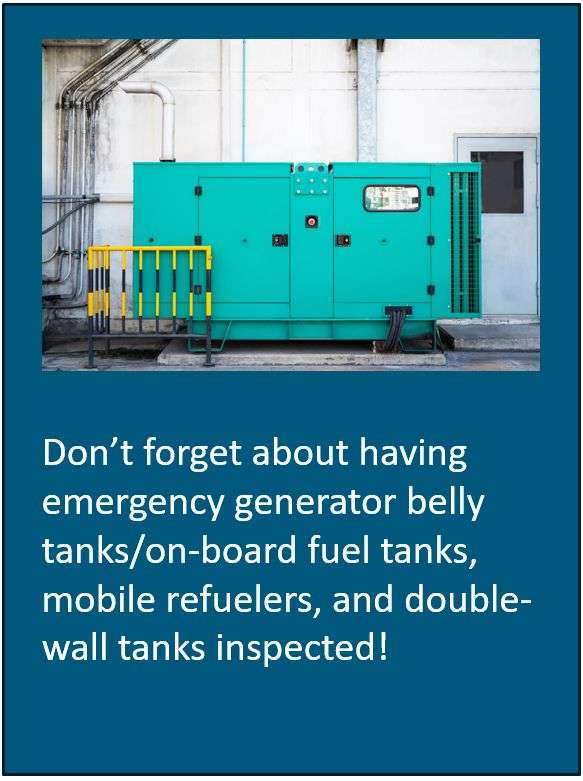
ASTs can be horizontal or vertical and constructed with single or double walls. While emergency generator belly tanks/on-board fuel tanks, mobile refuelers, and double-wall tanks are generally excluded from periodic inspections.
If your tank carries a manufacturer plate indicating compliance with the Underwriters Laboratory Standard (UL) or certain smaller American Petroleum Institute (API) standards, it can likely be inspected under the STI SP001 standard. Otherwise, field-erected tanks exceeding 30 feet in diameter or 50 feet in height should be inspected by a licensed inspector according to API standard 653.
Inspection Schedule
ASTs fall into three categories based on spill control measures and the presence or absence of a continuous release detection method (CRDM). CRDM involves detecting or observing liquid releases through tank design, such as installing an impermeable barrier or secondary containment. The categories are:
- Category 1: ASTs with spill control and CRDM
- Category 2: ASTs with spill control but without CRDM
- Category 3: ASTs without spill control or CRDM
Here’s a quick look at the periodic (P), external (E), internal (I), and leak test (L) inspection schedule for different tank sizes and categories.
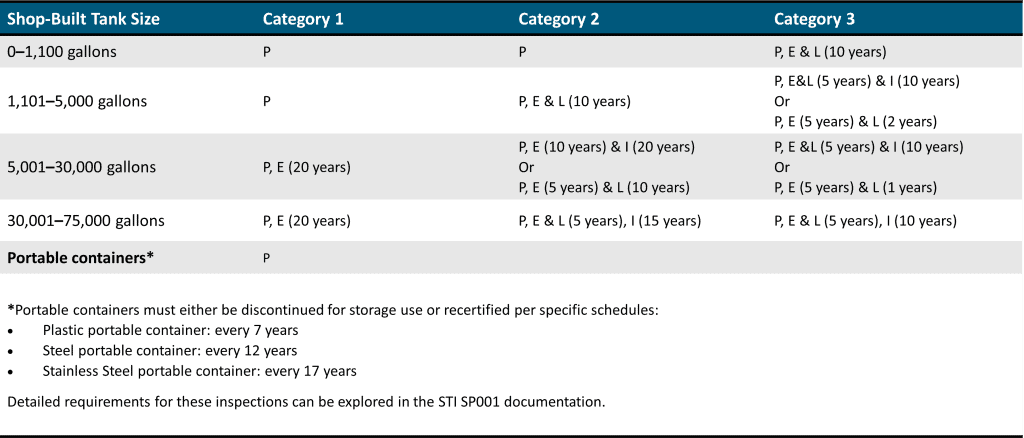
Periodic inspections include monthly and annual checks, conducted by the owner or an employee familiar with the tank system. A licensed inspector is not needed for these checks. Formal external and internal inspections must be performed by a qualified tank inspector certified by STI or API, with additional STI certification. Leak testing should be done by qualified personnel. For larger field-erected ASTs, refer to API Standards and consult a certified API 653 Inspector.
Inspection Focus Areas
During visual inspections of the interior, the inspector, owner, and qualified personnel familiar with the tank system should focus on these areas:
- Welds/Seams: Check for cracks, pinholes, or signs of failure at welds and seams throughout. Welds and seams typically have thicker Ultrasonic Thickness Testing readings versus other areas of the shell of the tank.
- Appurtenances: Inspect the condition of vents, fittings, ladders, and fasteners. Look for leaks at connections.
- Floor: Inspect floor plates, weld seams, and piping for any visual corrosion or imperfections. Conduct ultrasonic thickness testing to determine any potential metal loss.
- Shell & Heads (Horizontal Tanks): Inspect the tank shell plates and heads for corrosion, pitting, cracks, bulges, settlement, or deformities.
- Shell (Vertical Tanks): Inspect the tank shell plates and heads for corrosion, pitting, cracks, bulges, settlement, or deformities.
- Roof & Structure: Inspect roof plates for any indications of corrosion, holes, or cracks. Check weld seams and bolted connections.
Understanding and adhering to the STI SP001 standard is crucial for maintaining the safety and integrity of steel ASTs. Regular inspections not only comply with industry standards but also protect your operations and reduce risks associated with flammable and combustible liquids. For specific concerns or questions regarding your ASTs, please contact Sara Hlatky.
Inspection Checklists and Resources

Several resources for conducting STI SP001 inspections are available from the Steel Tank Institute's website, including monthly and annual checklists and records forms.

STI SP001 AST Record: https://stispfa.org/wp-content/uploads/2024/02/STI-SP001-AST-Record-7th-Edition.pdf
STI SP001 Monthly Inspection Checklist: https://stispfa.org/wp-content/uploads/2024/02/STI-SP001-Monthly-Inspection-Checklist-7th-Edition.pdf
STI SP001 Annual Inspection Checklist: https://stispfa.org/wp-content/uploads/2024/02/STI-SP001-Annual-Inspection-Checklist-7th-Edition.pdf
STI SP001 Portable Container Monthly Inspection Checklist: https://stispfa.org/wp-content/uploads/2024/02/STI-SP001-Portable-Container-Monthly-Inspection-Checklist-7th-Edition.pdf

The STI SP001 Inspection checklists and records forms are intended as templates. Feel free to develop your own checklists, and ensure they include equivalent content and meet all applicable inspection checklist items.

Sara Hlatky
Compliance Specialist
724-998-6691
sara.hlatky@ehs-support.com


